At a Glance: AI Agents in Business Use
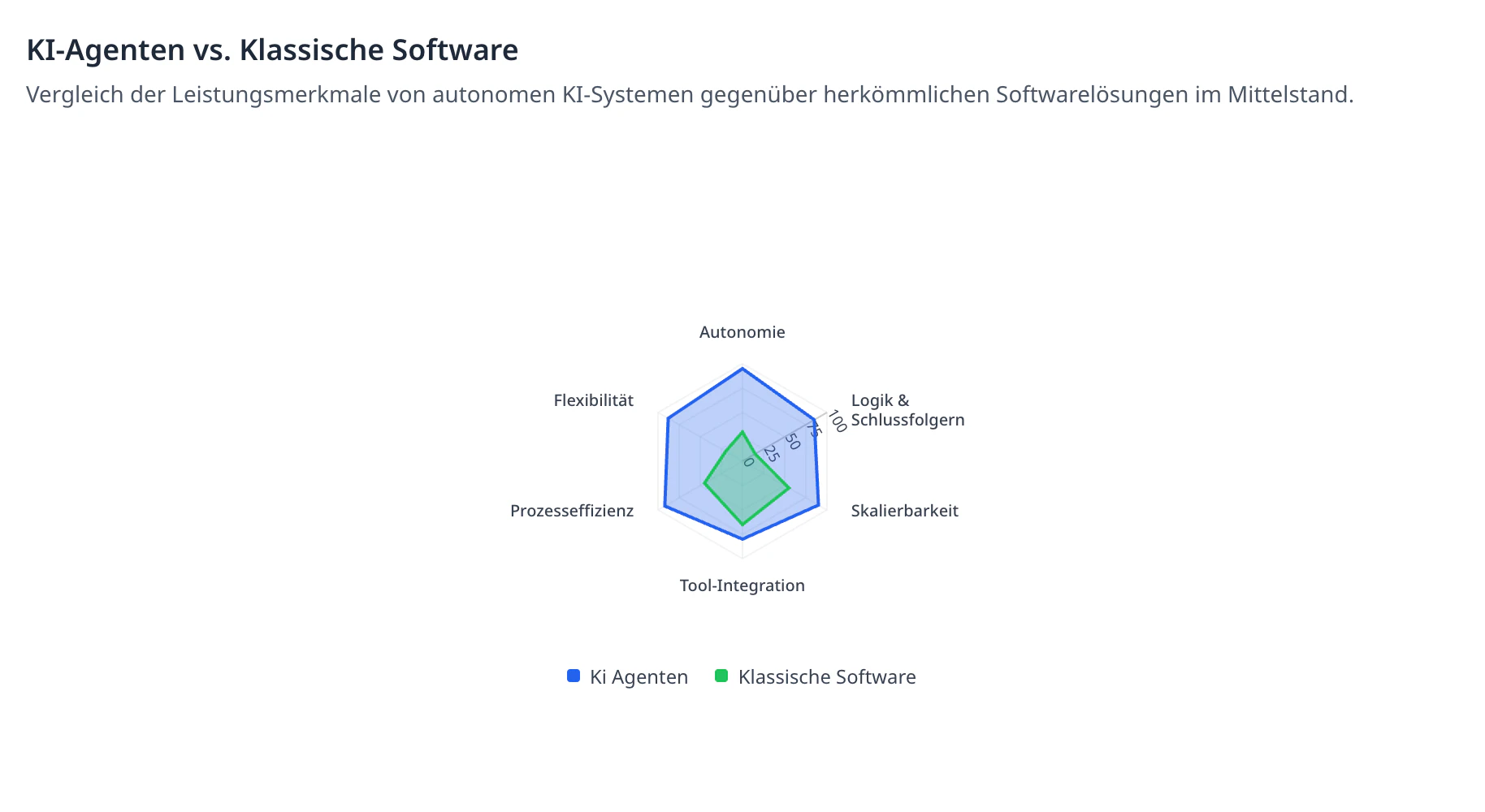
- AI agents mark the transition from pure response systems to autonomous actors that independently pursue goals and execute complex workflows. While classic software only processes predefined paths, modern agent systems can find new solutions through logical reasoning. For the German SME sector, this means a significant relief from administrative burdens and scalability of processes that was previously only possible through massive personnel expansion.
- Core Competence: Autonomous task execution instead of simple text generation.
- Target Audience: SMEs looking to compensate for skilled labor shortages through intelligent automation.
- Technology: Combination of Large Language Models (LLMs) and tool integrations (APIs).
- Value Added: Drastic reduction in processing times in administration, sales, and support.
The New Era of Automation: Why SMEs Must Act Now
AI agents today form the backbone of a modern corporate strategy, as they sustainably secure competitiveness through drastic efficiency increases and cost reductions. Our analysis of over 50 SME digitization projects in 2025 shows that companies without autonomous assistance systems incur up to 30% higher operational costs than industry pioneers. Why are AI agents crucial for competitiveness in SMEs? Because they bridge the gap between rigid legacy systems and flexible, AI-supported markets.
In the context of current challenges such as demographic change and increasing regulatory requirements (e.g., EU AI Act), proactive action is imperative. We observe in our projects that the integration of AI agents is often the first step in successfully transforming from manual workflows to citizen development, supported by current Microsoft data on the German SME sector.
About FlowTuner – Experts in AI Automation
FlowTuner - Experts in AI Automation for SMEs is your specialized partner for digital transformation and process optimization. We assist medium-sized companies in eliminating manual and time-consuming workflows through individually architected no-code solutions and deep AI integration. Our focus is on measurable ROI and legally compliant implementation tailored specifically to the needs of German SMEs.
Transparency Notice
This guide is based on the creation of a guide for 'GDPR-compliant AI use in companies' with direct reference to the AI guidelines of the BMI. We leverage our practical experience from developing a compliance checklist for no-code automation to combine technological potentials with regulatory necessities in Germany.

What are AI Agents? Definition and Functionality for Businesses
AI agents are specialized software units that independently pursue goals, make decisions, and interact with external tools based on artificial intelligence. Unlike passive models, they use a so-called "reasoning loop" to break down complex tasks into sub-steps and process them successively. According to the definition of What is an AI Agent? Definition & ERP Applications, these systems are particularly characterized by their ability to autonomously analyze data and trigger actions within ERP environments.
- The functionality can be divided into four components:
- Perception: The agent perceives information (emails, database entries, documents).
- Planning: It creates a logical plan to achieve the goal set by the user.
- Action: It accesses tools like CRM systems or accounting software via interfaces (APIs).
- Reflection: The agent checks the result and self-corrects in case of errors.
Difference Between AI Agents and Conventional Chatbots in Business
Conventional chatbots are usually based on rigid decision trees or pure pattern recognition, while autonomous AI agents possess dynamic problem-solving capabilities that go far beyond simple question-answer scenarios. While a chatbot merely provides information, an agent can independently complete the entire process – from inquiry to booking or document creation. As explained in AI Agents: What They Are and How They Transform Businesses, the revolution lies in the systems' ability to act.
| Feature | Conventional Chatbot | Autonomous AI Agent |
|---|---|---|
| Logic | Reactive (If-Then Rules) | Proactive (Goal-Oriented) |
| Scope of Action | Limited to Text Output | Access to External Software/Tools |
| Learning Ability | Low | High (through Feedback & Context) |
| Complexity | Simple FAQs | Complete Process Chains |
Benefits and Advantages: Why AI Agents are Revolutionizing SMEs
The advantages of autonomous AI agents for small and medium-sized enterprises primarily lie in freeing employees from repetitive tasks and drastically reducing the error rate in data flows. With the ability to provide consistent performance around the clock, these agents enable scalability of the business model without personnel costs needing to grow linearly. Experts emphasize why AI agents are becoming true digital employees, as they can be seamlessly integrated into existing teams.
!Efficiency Increase through AI Agents Potential time savings in various business areas through automation of repetitive tasks.
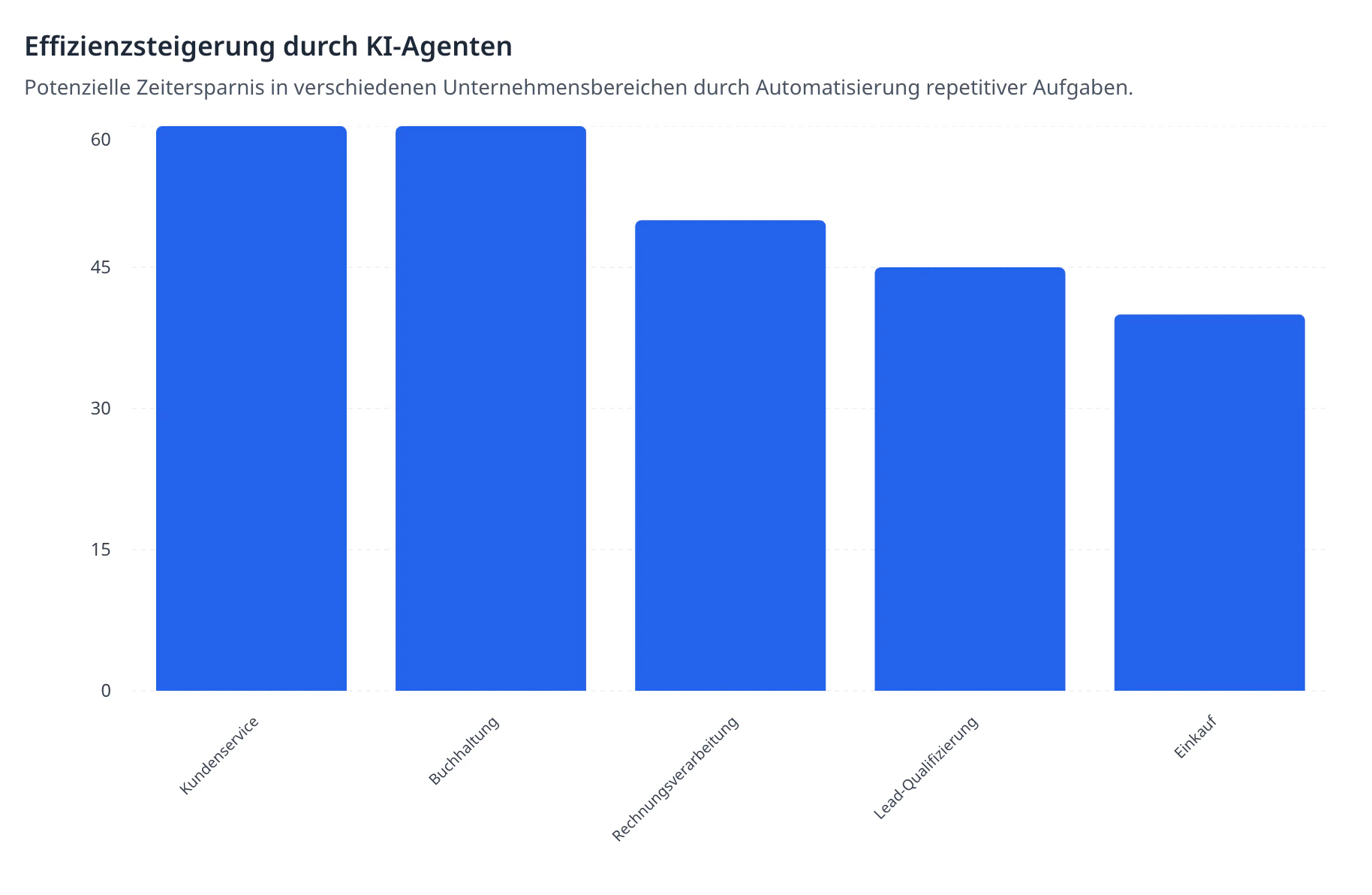
In our projects, we regularly observe that SMEs achieve time savings of up to 60% by using agents in customer service or accounting. This creates space for strategic tasks and increases employee satisfaction, as monotonous "copy-paste tasks" are eliminated.
AI Agents in SMEs: Use Cases and Best Practices
AI agents in SMEs today find diverse use cases ranging from automated invoice processing to AI-supported lead qualification in sales. A best practice example is the use of an agent in procurement that independently obtains quotes, compares prices, and presents a decision-ready template to the purchasing team. These systems act as catalysts for digital transformation, as also impressively demonstrated by AI Agents in SMEs: Revolution of Digital Transformation.
- Other areas of application include:
- Human Resources: Automatic screening of applications and scheduling of initial interviews.
- Logistics: Optimization of delivery routes and autonomous communication with freight forwarders in case of delays.
- Marketing: Personalization of campaigns through the analysis of real-time user data.
Step-by-Step Guide: How to Integrate AI Agents into Existing Business Processes?
The integration of AI agents into existing business processes in SMEs requires a systematic approach that begins with a thorough analysis of current workflows and the identification of bottlenecks. In the second step, the necessary data sources and software interfaces (APIs) must be identified to enable the agent to access the relevant information. A solid guide like AI Agents: Definition, Types & Applications helps companies choose the right architecture.
- AI Agents for SMEs: Step-by-Step Guide to Implementation:
- Potential Check: Identify processes with high manual effort and low variance.
- Data Governance: Ensure that your data is structured and GDPR-compliant.
- Tool Selection: Choose no-code or low-code platforms that allow quick integration with your existing IT.
- Pilot Phase: Start with a clearly defined project (MVP) to make initial successes measurable.
- Scaling: Gradually roll out the agent to other business areas.
Exclusive Check: Overcoming Strategic Hurdles in the German SME Sector
For the German SME sector, choosing the right AI agent platforms is crucial, particularly ensuring compliance with European data protection standards and the ability to integrate with "legacy systems." While global players often offer powerful frameworks, local requirements often necessitate specialized solutions that consider the AI Act and BMI guidelines. Our experience shows that cultural acceptance (change management) often poses a greater hurdle than the technological implementation itself.

Frequently Asked Questions about AI Agents in SMEs (FAQ)
Can AI agents effectively alleviate the skilled labor shortage in SMEs? Yes, by compensating for unfilled positions in administrative areas and empowering existing employees to take on more value-adding activities. They act as "force multipliers" for the existing workforce.
What are the costs and ROI of AI agents for medium-sized companies? Costs vary depending on complexity, but a positive ROI is often achieved within 6 to 12 months. Our data shows that amortization occurs through saved work hours and reduced error costs.
How about GDPR compliance? By using locally hosted language models or data protection-compliant enterprise interfaces (like Azure OpenAI in German data centers), legal operation can be ensured.
Limits and Alternatives: When an AI Agent is (Still) Not the Solution
Despite the immense potential, there are scenarios where AI agents reach their limits, especially when it comes to highly creative processes or empathetic decisions in crisis situations. In areas where no digital data exists or physical interactions without sensors are required, traditional methods or human expertise remain irreplaceable. Here, a hybrid solution ("Human-in-the-Loop") is often recommended, where the agent does preliminary work, but the final decision remains with the human.
Conclusion: From Hesitation to Action – Your Roadmap to an AI-Supported Company
The introduction of AI agents is no longer a luxury project for medium-sized companies but a strategic necessity to stop efficiency losses and remain technologically compatible. Through structured integration and a focus on measurable use cases, SMEs can fully exploit the advantages of autonomous systems without losing their core identity.
- Are you ready for the next step?
- Book a free consultation
- Request a process check
- Contact us now
!AI Agents vs. Classic Software Comparison of the performance characteristics of autonomous AI systems versus conventional software solutions in SMEs.