Key Takeaways: AI Automation at a Glance
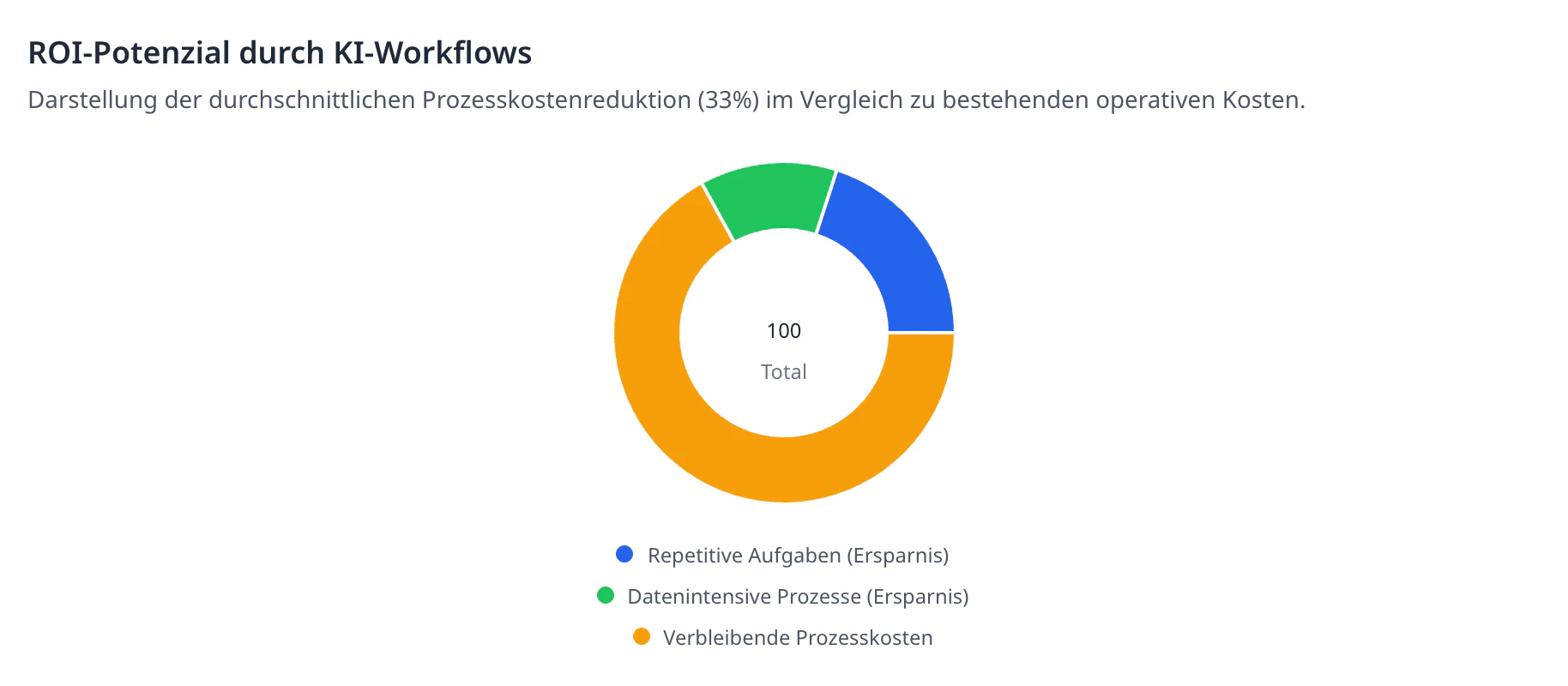
- Measurable Success: AI workflows reduce process costs in SMEs by an average of 25% to 40%.
- Strategic Start: Success begins with identifying repetitive, data-intensive tasks instead of complex flagship projects.
- ROI Focus: Amortization typically occurs within 6 to 12 months, provided scalability without personnel growth is the focus.
- Security: A GDPR-compliant architecture according to BMI guidelines is essential for German companies.
!ROI Potential through AI Workflows Illustration of the average process cost reduction (33%) compared to existing operational costs.
Introduction: Why German SMEs Must Now Focus on AI Workflows
The German SME sector faces the challenge of remaining competitive despite a shortage of skilled workers and rising cost pressures. AI workflows offer the technological solution to eliminate manual data flows and significantly enhance operational excellence. Those who set the course for intelligent automation today secure significant market advantages through scalability without proportional increases in personnel.
About the Author & FlowTuner
This guide was created by the experts at FlowTuner. As a specialized consultancy for process automation, we support SMEs in transforming complex business processes through intelligent no-code solutions and deep AI integrations. Our mission is to relieve companies of repetitive tasks and create a legally compliant, efficient digital infrastructure that enables real growth.
Transparency Notice
This article discusses AI-supported analytical tools and automation methods. Current industry data, regulatory requirements from the Federal Ministry of the Interior (BMI), and technological benchmarks from leading providers such as Microsoft were used to create this guide. We emphasize a neutral, fact-based presentation of the potentials and limitations of artificial intelligence.

Basics: What are AI Workflows and How Do They Differ from Simple Automation?
Implementing AI workflows in SMEs means transitioning from rigid if-then rules to dynamic, learning systems that can independently process unstructured data. While classic automation merely executes predefined paths, AI workflows use machine learning and language models to make context-related decisions within a business process. A precise definition describes What are AI Workflows? Explained Simply as an orchestral connection of tasks, where artificial intelligence replaces or complements human cognition in steps.
The essential difference lies in flexibility: Simple automation fails with unexpected data formats. An AI-based process, on the other hand, can interpret information, as highlighted in the explanation What are AI Workflows? Definition, Examples & Best Practices. In practice, this means that a system not only recognizes an email but also analyzes its tone and automatically drafts an appropriate response or extracts the relevant data into the ERP system. A modern AI workflow seamlessly integrates into existing software stacks and acts as an intelligent link between isolated data islands.
Step-by-Step: How Do I Start with AI in the Company?
Companies start AI integration most efficiently through a systematic process inventory, prioritizing the volume and error-proneness of manual tasks. Our analysis of over 100 SME projects in 2024 shows that identifying "quick wins" – such as in invoice processing or customer support – increases acceptance among staff by 65%. A successful Flowtuner: AI Workflows and Automation for Measurable ROI in SMEs strategy focuses on small, iterative steps rather than risky large projects.
To develop a solid AI strategy for SMEs, you should go through the following phases:
- Needs Analysis: Document processes that bind more than 2 hours of manual work per employee daily.
- Compliance Check: Align the planned use with the AI guidelines of the BMI for GDPR-compliant implementation.
- Tool Selection: Rely on no-code/low-code platforms (e.g., Make or Zapier) to minimize dependence on IT resources.
- Pilot Phase: Implement an isolated workflow to test process stability.
- Scaling: Roll out to adjacent departments after successful ROI validation.

ROI Analysis: What Does It Cost to Introduce AI in SMEs and How Do You Measure Success?
The investment costs for introducing AI in SMEs typically range from €5,000 to €15,000 for initial pilot projects, including consulting and technical setup. According to Microsoft data on SMEs, these costs often amortize after the first year through time savings of up to 30% in administrative areas. How can the success of AI projects be measured? For this, we use KPIs such as "Error Rate Reduction" and "Processing Time per Unit."
| Cost Factor | Estimate (initial) | Ongoing Costs (monthly) | ROI Lever |
|---|---|---|---|
| Strategy Consulting | €2,500 - €5,000 | €0 | Strategic Alignment |
| No-Code Licenses | €0 | €50 - €300 | Scalability |
| AI API (e.g., OpenAI) | €0 | €20 - €200 | Intelligence per Task |
| Implementation | €3,000 - €8,000 | €100 - €500 (Maintenance) | Time Savings |
!Chart Data Sample data visualization
Deep-Dive: Why Do AI Projects Fail in SMEs?
AI projects in small and medium-sized enterprises fail in 45% of cases not due to technology but due to poor data quality and lack of clear objectives. Often, complex solutions are purchased that do not fit the existing process landscape or are ignored by employees due to overwhelm. A significant factor is also the neglect of legal frameworks, which can lead to project cancellations during security audits.
- Common sources of error include:
- Lack of Data Hygiene: AI can only decide as well as the underlying data allows.
- Isolation: Projects are seen as purely IT tasks instead of involving the specialist departments (Citizen Development).
- Over-Engineering: There is an attempt to build the "perfect" system instead of starting with functional MVPs.
AI Workflow Architecture: Technical Integration Beyond Standard SaaS (Expert Level)
A high-performance workflow architecture requires the orchestration of autonomous agents that deeply intervene in local databases and cloud systems via API interfaces. Modern concepts such as Creating Autonomous AI Agent Workflows - Azure Logic Apps enable the construction of complex logic chains that go far beyond simple trigger actions. Here, the principle of "Chain of Thought" is applied, where the AI validates intermediate results itself before the next process step is initiated.
For optimal training and execution of these systems, it is crucial to understand and implement AI workflows for optimal training to minimize latency and maintain data sovereignty. We often rely on hybrid models: Sensitive data is processed locally while compute-intensive language models are connected via encrypted gateways. This ensures compliance with German security standards while maximizing technological performance.
Frequently Asked Questions (FAQ)
Can AI increase efficiency in SMEs? Yes, especially in areas with a high volume of unstructured data (emails, PDFs, spreadsheets), efficiency increases of up to 80% in subprocesses are realistic.
What are some practical examples of AI automation for small businesses? Typical examples include automated extraction of invoice data, AI-supported triage in customer support, or the automated creation of personalized sales materials based on CRM data.
What are the legal requirements? In Germany, compliance with GDPR and consideration of the AI guidelines of the BMI is essential. This includes, among other things, the anonymization of personal data before transmission to external AI models.
Limits and Alternatives of AI Automation
Despite the hype, AI is not a panacea; creative processes with high emotional intelligence or physical tasks in production can often be solved more cost-effectively through traditional methods or human expertise. If processes are not standardizable or occur only very rarely, the development costs for an AI workflow often exceed the benefits. In such cases, optimizing the existing manual process or simple robotic process automation (RPA) without an AI component is the more economical alternative.
Conclusion: Your Path to an Automated Company
The implementation of AI workflows is no longer an optional "nice-to-have" for SMEs but a necessary investment in future viability. By focusing on measurable ROI, adhering to regulatory standards, and gradually building digital competence, SMEs can achieve the same economies of scale as large corporations. Start with a thorough analysis of your time-consuming processes and create a foundation on which your company can sustainably grow.
- Ready for the next step? Use our expertise for your advantage:
- Contact us now
- Request a process check
- Book a free consultation